

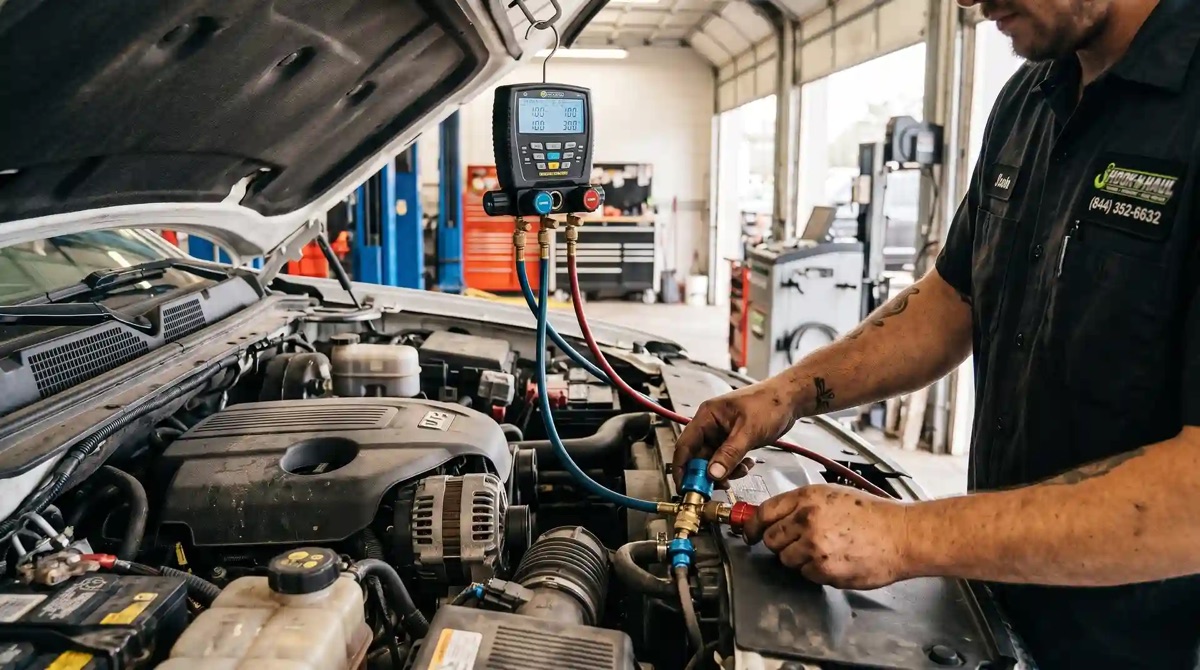
Stepping into a sweltering vehicle when your air conditioning blows warm air ruins any commute. Driving without cold air during humid summer months quickly turns into an exhausting safety hazard. Knowing how much it costs to recharge car AC helps you budget accurately and avoid overpaying at local repair shops.
Here at Hook-N-Haul, we diagnose vehicle climate control systems and handle complex mechanical repairs across Northeast Ohio. In this detailed pricing guide, you will learn exact shop labor rates, refrigerant price differences between R-134a and R-1234yf, and why skipping leak detection wastes your money.
Direct Answer: How Much Does It Cost to Recharge Car AC?
A professional car AC recharge costs between $150 and $500 in 2026, depending on your vehicle year and refrigerant type. For pre-2017 vehicles using standard R-134a refrigerant, complete shop service typically averages $150 to $250.
However, newer vehicles manufactured after 2017 require specialized R-1234yf refrigerant, which pushes total service bills to $350 to $500+. This complete professional service includes evacuating old gas, pulling a vacuum to boil out moisture, injecting ultraviolet leak dye, and recharging the system to exact factory weight specifications.
Refrigerant Type Breakdown: R-134a vs. R-1234yf Costs
Your vehicle model year determines which chemical cools your cabin, directly controlling your final invoice. Manufacturers switched to modern eco-friendly refrigerants to reduce global warming impacts.
| Refrigerant Type | Vehicle Model Years | Average Shop Recharge Cost | DIY Canister Kit Cost | Compatibility |
|---|---|---|---|---|
| R-134a | 1994 – 2016 Vehicles | $150 – $250 | $40 – $65 | Never mix with R-1234yf |
| R-1234yf | 2017 – Present Vehicles | $350 – $500+ | $90 – $145 | Requires specialized shop machines |
Check the white or yellow emissions sticker pasted underneath your engine hood to verify your exact refrigerant type. Never cross-contaminate these chemicals, because mixing refrigerants destroys expensive compressor valves and forces full system replacements.
According to environmental safety guidelines published by the U.S. Environmental Protection Agency, certified technicians must capture and recycle automotive refrigerants rather than venting them into the atmosphere.
What Drives the Cost to Recharge AC in Car Systems?
Understanding line-item charges prevents surprise bills when picking up your keys from the service desk. Several distinct factors influence how much it does cost to recharge AC in car models:
- Refrigerant Material Volume: Compact sedans hold roughly 14 to 18 ounces of gas, whereas large SUVs and commercial trucks with dual-zone rear cooling require up to 36 ounces.
- Shop Labor Rates: Certified technicians charge between $110 and $180 per hour to connect recovery machines, run pressure tests, and verify vent temperatures.
- Vacuum & Evacuate Cycle Time: Pulling a deep vacuum removes trapped air and moisture, taking 30 to 45 minutes on modern recovery stations.
- Diagnostic & UV Dye Injection: Shops add fluorescent dye during service to pinpoint slow rubber O-ring leaks using ultraviolet blacklights.
Pro Tip: Always ask your service advisor if the quoted recharge price includes ultraviolet leak detection dye. Paying an extra $15 for dye today saves hundreds of dollars in repeat diagnostic fees if your system loses pressure next month.
Additional AC Repair Costs: When a Simple Recharge Isn’t Enough
Automotive air conditioning operates as a completely sealed loop. Therefore, if your refrigerant level drops low, your vehicle definitely has a physical leak.
Simply refilling a leaking system provides cold air for only a few weeks before the gas escapes again. If pressure tests reveal damaged hardware, expect these additional repair costs:
- Schrader Service Valves: Replacing leaking high-side or low-side fill ports costs $80 to $200, including evacuation and recharge.
- Rubber O-Rings and Line Seals: Swapping brittle rubber line seals costs $120 to $300 depending on engine bay accessibility.
- AC Condenser Replacement: Road debris often punctures the front radiator-style condenser, costing $350 to $900 to replace.
- AC Compressor Assembly: Replacing a seized compressor along with a new receiver drier and system flush runs $700 to $2,000+.
For complete technical details on how compressors pressurize vapor into liquid, read about vapor-compression refrigeration cycles.
Can I Recharge My Car AC Myself? DIY vs. Professional Shop
Many drivers buy pressurized recharge cans at auto parts stores hoping to save money. While DIY kits appear simple, using them improperly frequently causes severe mechanical damage.
| Comparison Factor | DIY Store Canister Kit | Certified Repair Shop Machine |
|---|---|---|
| Upfront Price | $40 – $145 | $150 – $500 |
| Measurement Accuracy | Inaccurate low-side pressure guess only | Digital scale weighs refrigerant to the exact gram |
| Moisture Removal | None (Traps humid air inside lines) | Deep vacuum boils out destructive water vapor |
| Stop-Leak Sealants | Often contains glue that clogs expansion valves | Pure, clean manufacturer-approved refrigerant |
| Overcharge Risk | High risk of blowing compressor reed valves | Zero risk due to automated computerized dosing |
Store-bought canisters read only low-side pressure without revealing high-side spikes or exact refrigerant weight. Overfilling the system by just three ounces spikes head pressure, causing the compressor clutch to cycle violently and fail.
Pro Tip: Never buy DIY refrigerant cans labeled with “Stop Leak” additives. Those chemical sealants harden when exposed to air, permanently clogging tiny orifice tubes and ruining expensive shop recovery machines.
Common Pitfalls to Avoid During AC Service
Avoiding common climate control mistakes protects your wallet and extends compressor lifespan:
- Ignoring Weak Cabin Airflow: Sometimes warm air stems from a clogged cabin air filter or failing blower motor rather than low refrigerant. Always check airflow volume first.
- Running the AC With a Seized Compressor: Continuing to drive when the AC clutch pulley screeches can snap your serpentine belt, stranding your vehicle without power steering or alternator charging.
- Forgetting Winter AC Operation: Failing to run your defroster during winter lets rubber shaft seals dry out, causing refrigerant to leak out before spring arrives.
- Skipping Condenser Cleaning: Leaving road salt, dead bugs, and mud packed inside front condenser fins blocks heat transfer and overheats your AC system.
Climate Control & Roadside Fleet Service Across Northeast Ohio
Driving through Northeast Ohio exposes vehicle cooling systems to extreme temperature swings. Winter road salt along I-71, I-77, and the Ohio Turnpike corrodes aluminum AC lines rapidly, creating tiny pinhole leaks by June.
Whether you operate a daily commuter sedan or manage commercial freight rigs, keeping drivers cool prevents fatigue and improves road safety. If a seized AC compressor snaps your serpentine belt on the highway, our emergency team provides immediate road service truck repair to get you moving safely.
In addition, our field mechanics handle complex chassis and wheel end failures, including mobile axle spindle repair and heavy drivetrain diagnostics. Whenever unexpected breakdowns strike Cleveland, Akron, or Canton, trust our 24/7 mobile truck mechanic service for rapid on-site assistance.
Frequently Asked Questions
How long does a car AC recharge take at a shop?
A standard professional AC evacuation, vacuum leak test, and refrigerant recharge takes 45 to 75 minutes. However, R-1234yf recovery machines require longer automated safety checks, often taking closer to 90 minutes.
How often should you recharge your car AC?
You should never need routine AC recharges if your system remains airtight. Unlike engine oil or brake pads, refrigerant does not wear out or burn up during normal driving; low levels always indicate a physical leak.
Why is R-1234yf AC recharge so expensive?
R-1234yf refrigerant costs roughly four to five times more per pound than older R-134a gas due to manufacturing patents and stricter environmental standards. In addition, shops must invest in specialized anti-spark recovery machines to handle it safely.
What happens if you overcharge a car AC system?
Overcharging forces excessive liquid refrigerant back into the compressor, causing dangerous pressure spikes. As a result, the high-pressure safety switch shuts off cooling completely or destroys internal compressor valves.
Stay Cool and Safe With Expert Mechanical Service
Knowing how much it costs to recharge car AC empowers you to choose proper evacuation and leak testing over temporary fixes. Investing in accurate digital charging protects your compressor, delivers ice-cold cabin comfort, and prevents repeat repair bills every summer.
When climate control failures or mechanical emergencies disrupt your drive in Northeast Ohio, contact the certified technicians at Hook-N-Haul. Our experienced mechanics deliver honest diagnostics, reliable repairs, and rapid roadside support to keep your vehicles running smoothly in every season.