
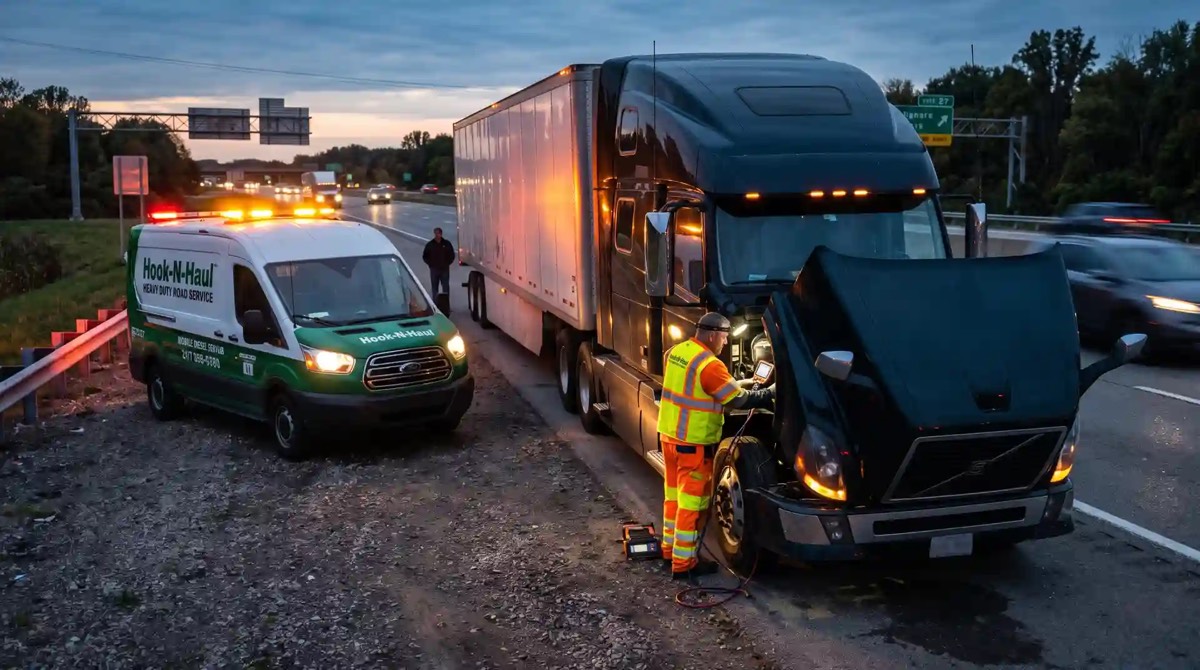
A sudden highway breakdown stalls your freight and triggers expensive delivery delays. Finding an immediate solution protects your operating schedule and prevents safety hazards on busy freight corridors. Fortunately, choosing a professional truck repair mobile service gets your commercial rig moving again without the massive expense of a long-distance tow.
Here at Hook-N-Haul, we deliver rapid roadside mechanical support across Northeast Ohio. In this comprehensive guide, you will learn how mobile mechanics diagnose breakdowns on-site, what services mobile units handle roadside, and why on-site repairs save fleets thousands in operational downtime.
What Is a Truck Repair Mobile Service and How Does It Work?
A mobile truck repair unit is a heavy-duty workshop built entirely inside an emergency response vehicle. Instead of forcing drivers to wait hours for a heavy wrecker, mobile technicians travel straight to your breakdown location. Specifically, these service trucks carry industrial air compressors, high-output generators, hydraulic jacks, torque multipliers, and original equipment manufacturer diagnostic laptops.
Technicians connect specialized diagnostic scanners directly to the commercial vehicle data port upon arrival. As a result, the technician reads active fault codes from the engine electronic control unit in real time. Because the mechanic carries common replacement components right inside the van, repair work starts immediately on the shoulder or freight terminal.
According to technical research by the American Trucking Associations, rapid roadside support prevents secondary collisions and keeps vital supply chains operating smoothly.
On-Site Capabilities: What Can a Mobile Mechanic Fix Roadside?
Modern mobile service trucks function as complete mobile garages capable of fixing complex mechanical, electrical, and pneumatic failures. Consequently, experienced technicians resolve the vast majority of non-structural roadside emergencies right on the spot:
- Computer Diagnostics & Derate Clearance: Technicians scan Cummins, Detroit, PACCAR, and Volvo engines to clear aftertreatment derate restrictions and execute forced diesel particulate filter regenerations.
- Pneumatic Air Line & Chamber Repairs: Mobile units carry brass compression fittings, nylon tubing, glad hands, and Type 30 air brake chambers to fix rapid pressure leaks.
- Starting & Charging Replacements: Technicians carry commercial heavy-duty batteries, gear-reduction starters, and high-output alternators to solve unexpected electrical no-start problems.
- Fuel System & Winter Gelling Fixes: In freezing temperatures, technicians thaw frozen fuel lines, replace clogged fuel-water separator filters, and treat fuel tanks with industrial de-icers.
- Axle Spindle & Wheel Bearing Repair: Specialized field units rethread stripped spindle stubs or install precision sleeves without pulling the entire axle tree.
Pro Tip: When you pull onto the highway shoulder with a mechanical issue, immediately drop your trailer air suspension if parking on an uneven slope. This simple step keeps the freight weight balanced and prevents trailer frame twisting while waiting for service.
Emergency Roadside Repair vs. Heavy Towing: Cost & Time Comparison
Deciding between calling a mobile repair van and booking a heavy wrecker directly impacts your balance sheet. In fact, towing a Class 8 semi-truck to an independent repair facility introduces several hidden expenses that mobile mechanics avoid completely.
| Breakdown Factor | Mobile Truck Repair Service | Heavy-Duty Towing to Shop |
|---|---|---|
| Typical Response Time | 30 to 60 Minutes On-Site | 60 to 120 Minutes for Wrecker Arrival |
| Average Initial Cost | $250 – $650 (Service Call + Labor) | $800 – $2,500+ (Hook Fee + Mileage) |
| Facility Waiting Queue | None (Technician works immediately) | 1 to 4 Days (Waiting for shop bay opening) |
| Drivetrain Disconnect Risk | Zero risk (Truck stays stationary) | High risk of transmission damage if pulled incorrectly |
| Total Average Downtime | 2 to 4 Hours | 24 to 72 Hours |
Therefore, scheduling road service truck repair eliminates astronomical tow bills while keeping your cargo moving on schedule. Furthermore, our specialized field teams protect your equipment integrity from start to finish.
Navigating Engine Derate Codes & Emissions Failures Roadside
Modern commercial clean-diesel engines depend heavily on exhaust aftertreatment systems. When sensors detect soot accumulation or selective catalytic reduction faults, the engine computer cuts vehicle speed down to 5 MPH.
TYPICAL DIESEL AFTER-TREATMENT FLOW
| Step / Flow | Component Name | Primary Function |
|---|---|---|
| Stage 1 | Engine Exhaust | Directs hot raw exhaust gas away from the engine cylinders |
| Stage 2 | DOC (Diesel Oxidation Catalyst) | Breaks down unburnt hydrocarbons and carbon monoxide gas |
| Stage 3 | DPF (Diesel Particulate Filter) | Traps harmful black soot and particulate matter from exhaust flow |
| Stage 4 | DEF Injection Valve | Sprays measured diesel exhaust fluid mist into the exhaust stream |
| Stage 5 | SCR (Selective Catalytic Reduction) | Converts toxic nitrogen oxides into harmless nitrogen and water |
When this safety restriction activates on major freight routes like the Ohio Turnpike, drivers cannot reach a dealership safely. However, a mobile technician plugs directly into your heavy-duty J1939 diagnostic connector on the roadside.
Next, the technician performs an automated stationary exhaust regeneration cycle to burn off trapped carbon. Finally, the mechanic clears the latched torque limiters, restoring full horsepower and vehicle road speed within ninety minutes.
Common Pitfalls to Avoid During Commercial Breakdowns
Reacting improperly during an unexpected mechanical breakdown creates serious safety risks and inflates your repair bill. Drivers and fleet dispatchers must avoid these costly mistakes:
- Parking on Soft Highway Shoulders: Pulling a loaded 80,000-pound combination vehicle onto soft dirt or mud sinks the outer tires, making jacking impossible without expensive crane support.
- Forcing Frozen Air Brakes: Dragging trailer tires across dry asphalt to break ice out of frozen brake drums destroys expensive tires and cracks cast-iron hubs.
- Clearing Codes Without Physical Fixes: Resetting engine warning lights using basic consumer scan tools without fixing the underlying sensor failure triggers immediate re-derate ten miles down the road.
- Ignoring Drivetrain Disconnect Requirements: Towing a semi-truck without removing the axle shafts burns out differential planetary gears due to lack of pressurized lubrication.
Pro Tip: Before calling dispatch, take clear digital photos of your dashboard fault lamps and locate the stamped engine serial number on the valve cover. Providing this information allows the responding mobile technician to bring the exact replacement sensors directly to your location.
Fast Mobile Response Along Northeast Ohio Freight Corridors
Northeast Ohio serves as one of the busiest industrial logistics crossroads in the entire United States. Interstates like I-71, I-77, I-90, and I-80 support thousands of commercial freight runs every single day. Because our region experiences extreme lake-effect snow and heavy road salt exposure, equipment faces severe stress year-round.
When commercial vehicles break down near Cleveland, Akron, Canton, or Elyria, dispatch speed makes all the difference. Hook-N-Haul positions fully equipped service vans across strategic transit junctions to guarantee rapid arrival times.
Whether your trailer suffers blown air hoses or requires precision axle spindle repair, our certified field technicians resolve failures quickly. Moreover, our team ensures full compliance with FMCSA commercial vehicle maintenance regulations before your vehicle returns to the highway.
Frequently Asked Questions
How fast does a truck repair mobile service arrive during an emergency?
Most professional mobile units arrive at highway breakdown locations within 30 to 60 minutes. Because response teams stage service trucks near major interstate intersections, dispatchers send the closest technician immediately.
What repairs can a mobile truck repair service handle on-site?
Mobile technicians handle air brake line failures, starter replacements, alternator swaps, burst coolant hoses, fuel filter clogs, wheel seal leaks, and emergency electrical wiring repairs on-site.
Is mobile truck and trailer repair cheaper than towing to a shop?
Yes, mobile repair is significantly cheaper because you avoid heavy-duty hook fees, per-mile towing charges, and prolonged repair shop labor premiums. In addition, you save several days of missed freight revenue.
Do mobile truck repair services operate 24/7 on highways?
Yes, reputable commercial mobile services operate 24 hours a day, 7 days a week, 365 days a year. Highway freight never stops, so emergency mobile dispatchers answer roadside calls at all hours.
Can a mobile diesel mechanic clear engine derate codes roadside?
Yes, certified mobile mechanics carry OEM-level diagnostic laptops capable of forcing DPF regenerations, resetting DEF quality fault codes, and removing engine derate speed caps right on the highway shoulder.
Restore Highway Uptime with Expert Roadside Support
A highway breakdown does not have to ruin your delivery schedule or drain your fleet operating budget. Choosing a high-capacity mobile repair unit brings certified master technicians, dealer-grade diagnostics, and genuine commercial components directly to your truck.
When unexpected mechanical failures halt your vehicle in Northeast Ohio, contact Hook-N-Haul immediately for fast, reliable 24/7 mobile truck mechanic service. Our dedicated road response teams will arrive promptly, resolve the breakdown on-site, and get your freight back on the road safely.