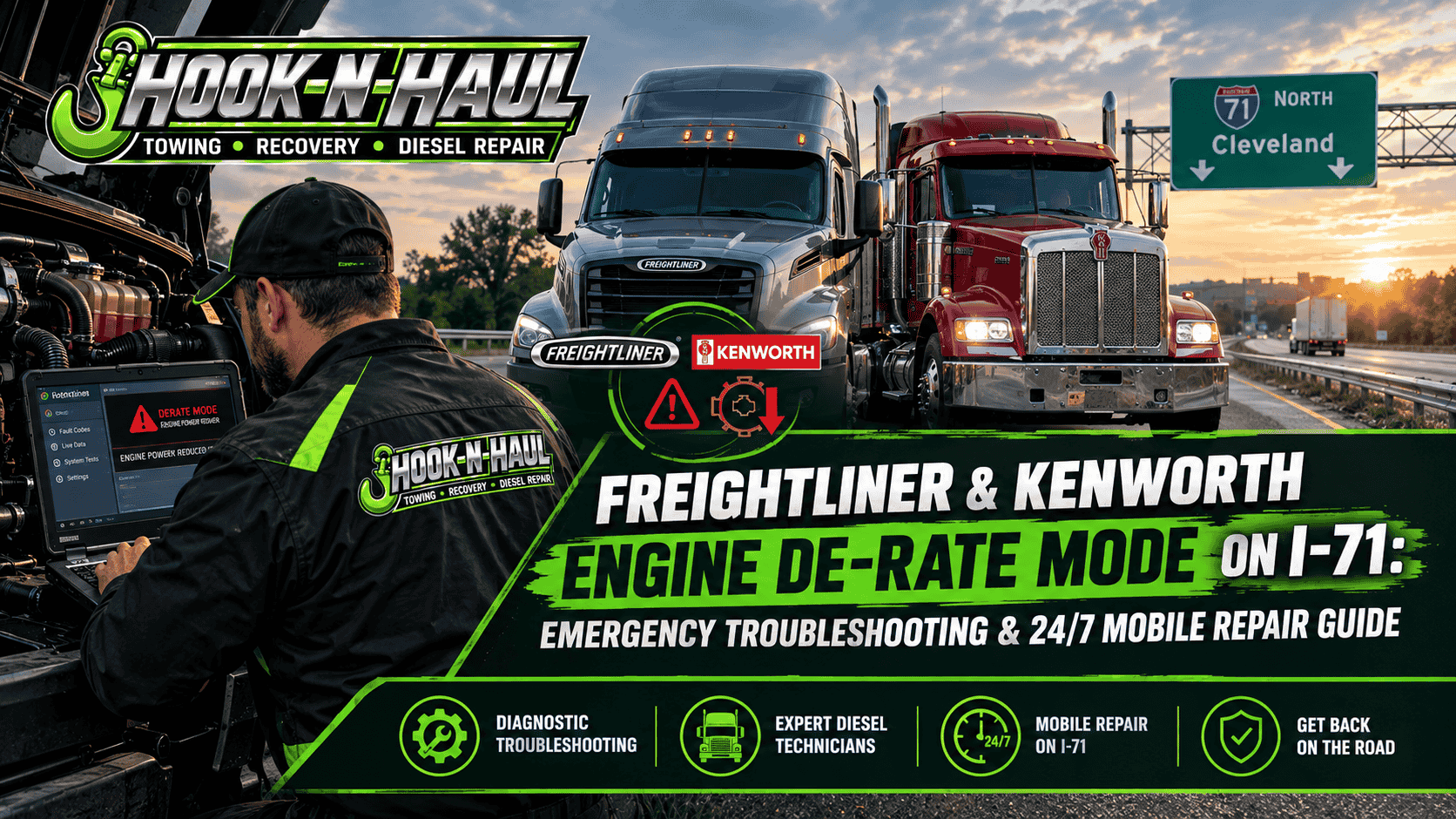
It is 3:00 AM on Interstate 71. You are hauling a time-sensitive freight load through Medina County, Ohio, when your dashboard suddenly lights up like a Christmas tree. Within seconds, a warning flashes across your driver display: ENGINE DE-RATE IN 60 MINUTES or SPEED LIMITED TO 5 MPH.
Consequently, your heart sinks. Your RPMs drop, your throttle pedal loses responsiveness, and a 500-horsepower rig suddenly feels like a golf cart pulling 80,000 pounds up a grade.
Whether you operate a Freightliner Cascadia with a Detroit DD15 or a Kenworth T680 powered by a PACCAR MX-13 or Cummins X15, getting caught in engine de-rate mode on I-71—one of Northern Ohio’s most heavily traveled commercial freight corridors is a high-stress scenario. Every minute you spend sitting on the shoulder between Cleveland, Columbus, and Mansfield leads to lost revenue, missed delivery windows, and growing safety risks.
🚨 NEED IMMEDIATE MOBILE DIESEL DIAGNOSTICS ON I-71?
Don’t pay for an expensive, unnecessary long-distance tow before running on-site computer diagnostics. Hook-N-Haul Recovery Repair Towing & Transport dispatches fully equipped mobile diagnostic units 24/7/365 across I-71, I-80, I-77, and I-76.
📞 Call Our 24/7 Dispatch Hotline Now: (844) 352-6632
What Is Engine De-Rate Mode and Why Does It Happen?
Engine de-rate mode is an automated protective feature built into modern heavy-duty commercial truck Electronic Control Units (ECUs). Governed strictly by Environmental Protection Agency (EPA) emissions mandates and engine safety thresholds, de-rate mode intentionally restricts your engine’s horsepower, torque, and vehicle speed.
Typically, the engine computer triggers de-rate mode for two main reasons:
- Emissions Non-Compliance: The diesel aftertreatment system (DEF, DPF, SCR, or NOx sensors) detects a system malfunction, chemical imbalance, or sensor failure that exceeds legal emissions limits.
- Critical Mechanical Protection: Engine sensors detect unsafe operating conditions such as severe overheating, oil pressure loss, or boost leaks that could cause catastrophic internal engine destruction if allowed to run at full power.
| De-Rate Severity Level | Operating Restriction | Driver Action Required |
| LEVEL 1: Warning Level | 15% to 25% Torque Reduction | Safe to exit highway; address code soon. |
| LEVEL 2: Speed Restrict | Capped at 55 MPH or 25 MPH | Safety hazard on I-71; pull off at next exit immediately. |
| LEVEL 3: Severe / Shutdown | Restricted to 5 MPH or Engine Shutdown | Vehicle disabled; requires immediate mobile repair or towing. |
Understanding the progression of de-rate levels helps drivers and fleet owners make split-second decisions safely along busy highway corridors like I-71.
The 3 Stages of Engine De-Rate (And What They Mean on I-71)
Modern heavy-duty trucks do not usually drop to 5 MPH without prior warning. Instead, the ECU executes a progressive multi-stage countdown designed to give you time to pull off the highway safely.
Stage 1: Mild Power & Torque Reduction (15% – 25% Power Loss)
- What Happens: First, the check engine light or yellow Aftertreatment Warning light illuminates. Next, your ECU limits torque output, making acceleration sluggish, especially on incline grades along I-71 near Mansfield or Richland County.
- Can You Drive? Yes, but only long enough to reach the nearest exit, rest area, or weigh station. Furthermore, continuing to drive without addressing the fault code will trigger Stage 2 within a set timeframe or mileage limit (typically 50 to 100 miles).
Stage 2: Speed Restriction (Limited to 55 MPH or 25 MPH)
- What Happens: During this phase, the stop engine or amber warning indicator begins flashing, accompanied by an audible dash chime. As a result, your truck’s maximum speed is automatically capped.
- Can You Drive? Driving on I-71 at 25 MPH creates a severe safety hazard for oncoming freight traffic and passenger cars. Therefore, staying on the main highway is extremely dangerous at this point. You must safely maneuver onto the shoulder or pull off at the next exit immediately.
Stage 3: Severe De-Rate / Shutdown (5 MPH or Engine Cutoff)
- What Happens: Eventually, the dreaded red STOP ENGINE lamp illuminates. Your ECU restricts your engine to a crawl speed (5 MPH) or shuts the engine off completely after a 30-to-60-second idling countdown.
- Can You Drive? No. At this point, your rig is officially out of commission. Attempting to restart the truck will either fail or leave you stuck in a 5 MPH limp mode. Consequently, this stage requires an immediate call for mobile roadside repair or heavy-duty recovery.
Freightliner vs. Kenworth: Common Triggers & Fault Codes
While both brands rely on advanced aftertreatment architectures, Freightliner (Detroit Diesel) and Kenworth (PACCAR / Cummins) display unique fault codes and fail-safes when entering de-rate mode.
| Truck Brand & Engine | Common Trigger Cause | Typical Dash Warning / Fault Code |
| Freightliner Cascadia (Detroit DD13 / DD15) | • Bad DEF Quality / NOx Sensor • DPF Soot Load Over 150% | • DEF Line Pressure Low • Parked Regen Required |
| Kenworth T680 / W990 (PACCAR MX13 / Cummins X15) | • DEF Pump Module Failure • SCR Catalyst Degradation | • Engine Power Reduced 1 hr • Code 3582 / Code 3714 |
Freightliner Cascadia (Detroit DD13 & DD15 Engines)
Freightliner Cascadias dominate commercial long-haul corridors like I-71. The Detroit Diesel aftertreatment system relies on a One-Box configuration housing the DPF, DOC, SCR, and NOx sensors.
Top Causes of Freightliner De-Rate:
- NOx Sensor Failures (Inlet or Outlet): Moisture, soot buildup, or thermal shock often damages the delicate ceramic element in NOx sensors. Because of this, when the ECU receives erratic voltage readings, it triggers an instant 55-MPH de-rate.
- DEF Dosing Valve Clogging: Crystallized Diesel Exhaust Fluid (DEF) blocks the doser nozzle. Consequently, this prevents urea injection into the SCR catalyst.
- DPF High Soot Accumulation: If passive regeneration fails during prolonged highway driving, the Diesel Particulate Filter chokes on soot, forcing a mandatory parked regen or a forced computer reset.
Kenworth T680 & W990 (PACCAR MX-13 & Cummins X15)
Kenworth trucks running PACCAR or Cummins power plants use complex sensor arrays to measure exhaust backpressure, DEF fluid concentration, and fluid temperatures.
Top Causes of Kenworth De-Rate:
- DEF Quality Sensor (Poor DEF Concentration): PACCAR and Cummins systems monitor urea concentration inside the DEF tank. For example, if DEF concentration drops below 32.5% due to water contamination, old DEF, or sensor head failure, the system initiates a 50-mile countdown to a 5 MPH de-rate.
- DEF Pump Pressure Loss: Internal fluid leaks or air-assist pump failures prevent the system from building the required ~90 PSI line pressure.
- EGR Valve Carbon Plugging: Heavy carbon deposits prevent the Exhaust Gas Recirculation (EGR) valve from seating properly. As a result, this disrupts air-to-fuel ratios and triggers engine protection modes.
Step-by-Step Emergency Guide: What to Do on I-71
If your truck flashes an engine de-rate warning on I-71 near Litchfield, Medina, Richfield, or Seville, execute this safety and recovery checklist immediately:
Step 1: Prioritize Scene Safety Immediately
- Move to the Right Shoulder or Exit: Pull as far off the travel lane as possible onto a paved shoulder or paved exit ramp (e.g., Exit 209 for Litchfield/Medina or Exit 218 for Seville).
- Activate Hazard Lights: Turn on four-way flashers immediately to alert approaching traffic.
- Deploy Warning Triangles / Flares: Set out reflective triangles at 10 feet, 100 feet, and 200 feet behind your trailer per DOT regulations.
Step 2: Check Your DEF Tank & Fluid Quality
- Inspect Fluid Levels: Ensure your DEF tank is not empty because running completely dry triggers an immediate forced de-rate.
- Inspect DEF Appearance: Open the cap safely and inspect the fluid. Check whether it appears crystal clear or looks cloudy and contaminated. Additionally, ensure nobody accidentally poured diesel fuel or windshield wash into the DEF tank.
Step 3: Attempt a Manual Parked Regeneration (If Prompted)
If your dash light specifically reads “REGEN REQUIRED” or displays the DPF filter symbol:
- Park the truck safely on a level surface away from tall grass or flammable material.
- Set the parking brake and place the transmission in Neutral.
- Ensure engine coolant temperature is above 150°F (65°C).
- Press and hold the dash-mounted Parked Regen Switch for 3 to 5 seconds.
- If the RPMs rise to 1,100–1,400 RPM, allow the 30-to-45-minute process to finish completely.
⚠️ CRITICAL WARNING: However, if your truck has already entered Stage 3 (5 MPH / Red Stop Engine Light), a manual parked regen will be locked out by the ECU. At this stage, flipped dashboard switches will not clear the fault code without factory-level computer diagnostic software.
Step 4: Call Hook-N-Haul Mobile Diesel Diagnostics
When dash switches fail to clear the code, do not attempt to clear fault codes by disconnecting your battery cables. Disconnecting battery terminals on modern Freightliner and Kenworth trucks wipes ECU adaptive memory, causes communication errors across CAN-bus networks, and will not clear emission-related de-rate latches.
Instead, call a certified mobile diesel technician equipped with factory OEM diagnostic software (Detroit Diagnostic Link, Cummins INSITE, or PACCAR DAVIE4).
Mobile Repair vs. Towing: Which Do You Need?
When your semi truck breaks down on I-71, one of the biggest financial decisions you face is choosing between a mobile diesel repair unit and a heavy-duty wrecker tow.
| Breakdown Scenario | Recommended Solution | Primary Benefit |
| DEF Sensor Fault / Software Latch | ⚡ Mobile Diesel Repair | On-site software reset; no tow needed. |
| Clogged DEF Dosing Nozzle / Frozen Line | ⚡ Mobile Diesel Repair | On-site part replacement. |
| DPF Soot Lockout (Requires Force Regen) | ⚡ Mobile Diesel Repair | Laptop-forced regen on shoulder. |
| Internal Engine Knocking / Mechanical Damage | 🚛 Heavy-Duty Towing | Transport to full repair shop. |
| Broken Crankshaft / Blown Transmission | 🚛 Heavy-Duty Towing | Safe transport for major overhaul. |
When Mobile Repair Saves You Thousands
In over 65% of roadside engine de-rate incidents, the issue is electronic or component-based, not a destroyed engine.
For instance, a mobile service technician arrives on-site on I-71 with laptop diagnostics to:
- Perform a computer-forced DPF regeneration on the shoulder.
- Replace failed inlet/outlet NOx sensors on-site.
- Swap out a faulty DEF header or DEF dosing injector.
- Command an ECU software reset and clear the permanent de-rate latch.
As a result, you get back on the road in 1 to 2 hours for a fraction of the cost of a long-distance heavy tow.
When Heavy-Duty Towing Is Unavoidable
On the other hand, if mobile computer diagnostics reveal catastrophic mechanical failure such as spun main bearings, dropped valves, cracked cylinder heads, or severe transmission failure mobile repair on a highway shoulder becomes unsafe and impractical.
In these cases, Hook-N-Haul dispatches heavy duty 50-ton wreckers and rotators to safely tow your loaded tractor-trailer to one of our full-service repair facilities in Litchfield or Richfield, Ohio.
How Hook-N-Haul Solves De-Rate Emergencies Fast
At Hook-N-Haul Recovery Repair Towing & Transport, we operate over 50 service vehicles and two fully equipped heavy truck repair facilities strategically stationed along major Northeast Ohio logistics hubs.
When you call our 24/7 dispatch center during an I-71 breakdown, we execute a fast, 4-step recovery process:
- Rapid 24/7 Dispatch: First, we immediately deploy roadside units along I-71, I-80, I-77, and I-76.
- On-Site OEM Diagnostics: Next, our technicians perform laptop scans using Detroit Diagnostic Link, Cummins INSITE, or PACCAR DAVIE4.
- Roadside Component Swap or Force Regen: Then, we complete targeted repairs directly on the shoulder, aiming for completion in under 2 hours.
- Seamless Heavy Wrecker Towing: Finally, if major mechanical overhauls are required, we provide direct towing transfers to our Litchfield or Richfield shops.
Strategic I-71 Location Coverage
Our mobile repair units and heavy wreckers are stationed near critical interstate intersections to guarantee fast roadside response times across:
- Medina County: I-71 corridor (Exits 204 to 218), Litchfield, Seville, Lodi.
- Cuyahoga & Summit Counties: I-71 north junction to I-80 (Ohio Turnpike), Richfield.
- Lorain & Ashland Counties: I-71 south corridor through Elyria, Amherst, and Mansfield.
Preventative Tips to Prevent Engine De-Rate on Ohio Interstates
- Use Premium, Fresh Diesel Exhaust Fluid (DEF): Always purchase DEF from high-volume truck stops along major interstates to ensure fresh inventory. Meanwhile, avoid buying old, sun-baked DEF jugs stored outside in summer heat.
- Replace DEF Tank Filters on Schedule: Replace your DEF pump filter every 150,000 to 200,000 miles (or according to manufacturer guidelines) to prevent pump pressure dropouts.
- Inspect NOx Sensor Wiring Harnesses Before Winter: Cold weather, road salt, and liquid de-icers used heavily on Ohio highways corrode sensor wiring harness connectors. Therefore, apply dielectric grease to exposed plugs during fall PM inspections.
- Address Warning Lights Immediately: Never ignore a yellow check engine light or mild Stage 1 de-rate warning hoping it will clear itself. Ultimately, addressing a sensor code early prevents severe 5-MPH highway shutdowns.
Frequently Asked Questions (FAQ)
Can I drive my truck in engine de-rate mode?
You can drive short distances in Stage 1 (mild torque reduction) to safely reach an exit or rest stop. However, driving in Stage 2 or Stage 3 (25 MPH or 5 MPH limits) on I-71 is dangerous and will cause severe traffic hazards.
How do I clear an engine de-rate on a Freightliner Cascadia on-site?
If a manual parked regen does not clear the code, an on-site computer reset using Detroit Diagnostic Link software is required. Furthermore, disconnecting battery cables will not clear modern aftertreatment de-rate latches.
Will poor DEF quality cause engine de-rate?
Yes. For example, if your DEF tank fluid drops below 32.5% urea concentration or becomes contaminated with water, fuel, or debris, the ECU triggers a mandatory 50-mile countdown to a 5 MPH de-rate limit.
How much does mobile diesel repair cost compared to heavy towing on I-71?
Mobile diesel diagnostic repair typically saves operators 50% to 70% compared to the combined costs of a heavy-duty tow, shop storage fees, and extended fleet downtime.
📞 STRANDED IN DE-RATE MODE ON I-71? CONTACT HOOK-N-HAUL NOW!
Don’t let an unexpected aftertreatment error or engine de-rate lock out your freight delivery. Whether you’re stranded near Medina, Richfield, Seville, Litchfield, or Mansfield, Hook-N-Haul Recovery Repair Towing & Transport is ready to assist 24/7/365.
• 24/7 Emergency Roadside Dispatch: (844) 352-6632
• Main Shop & Operations Center: 9225 Stone Rd, Litchfield, OH 44253
• Website: https://hook-n-haul.com/